Showing posts with label complexity. Show all posts

Monday, June 23, 2025

Getting Things Done as a System: Becoming Like Water


"Water is what it is, and does what it does. It can overwhelm, but it’s not overwhelmed. It can be still, but it is not impatient. It can be forced to change course, but it is not frustrated. Get it?" 

– David Allen, Getting Things Done


INPUTS (Uncontrollable, Constant Flow)

  • Emails
  • Meetings
  • Deadlines
  • Crises
  • Unexpected events

Step 1: Capture ("Container for Flow")

  • Collect all incoming information (notes, inboxes, voice memos, lists)
  • Don't resist the incoming current, just catch it

Step 2: Clarify ("Remove Debris")

  • Process each captured item: What is it? Is action needed?
  • Define next actions, projects, reference material
  • Let go of ambiguity (clearing the water)

Step 3: Organize ("Directing Channels")

  • Sort clarified items into systems:

    • Next actions
    • Waiting for
    • Projects
    • Someday/maybe
    • Calendar
  • Each item flows into an appropriate channel

Step 4: Reflect ("Monitoring Currents")

  • Weekly reviews
  • Reconnect with priorities
  • Adjust the system as needed

Step 5: Engage ("Act With Flow")

  • Work from trusted lists
  • Choose actions based on context, time, energy, priority
  • Stay present and responsive, like water flowing around obstacles


Core System Qualities ("Water-Like Mindset")

  • Adaptable
  • Non-resistant
  • Emotionally neutral
  • Always moving, never stuck
  • Calm even when fast-moving
  • Changes form without losing essence


Mindset Shift

Instead of fighting complexity or feeling overwhelmed:

  • Trust the system to hold the complexity.
  • Allow your mind to stay clear and present.
  • Flow with change instead of resisting it.

"Water is what it is, and does what it does."


Systems Thinking Layer:

Your mind + GTD system = an adaptive human-technical system operating inside larger dynamic systems (work, family, world events).

  • Feedback loops: Regular reviews keep the system calibrated
  • Emergence: Complex projects unfold through iterative small actions
  • Path dependence: Early clear captures reduce downstream chaos


Mindfulness Layer:

  • Presence without reactivity
  • Awareness of flow and obstacles without attachment
  • Acceptance of what arises, acting skillfully in response


David Allen's implicit lesson:

"You cannot control the river. But you can learn to move like water."

Saturday, June 21, 2025

Systems: Emergent Attractors

In systems thinking, an attractor is a kind of “preferred pattern” that a complex system tends to settle into over time. Imagine dropping a marble onto a landscape of hills and valleys — the marble may roll around for a while, but eventually it will settle into one of the valleys. That valley is like an attractor: once the system is there, it tends to stay there unless something significant knocks it out. The same idea applies to social systems, economies, ecosystems, or political movements — certain patterns of behavior, relationships, and feedback reinforce themselves and become stable over time.

Not all attractors are equally healthy or desirable. Some attractors produce stable democracies, functioning markets, or resilient communities. Others lead to destructive outcomes, like authoritarian regimes, cycles of poverty, or ecological collapse. What makes systems change so challenging is that once a system has settled into a particular attractor, it resists change — small reforms may slide right back into the same old patterns. Moving a system to a new attractor usually requires shifting multiple elements at once: narratives, incentives, power structures, and feedback loops.

The idea of attractors helps us see why complex problems don’t always respond to linear solutions. Instead of asking “what’s the fix?”, systems thinking asks “what keeps pulling the system into this pattern — and how do we reshape the deeper forces so that healthier patterns can emerge and sustain themselves?”


In complex social systems, stability often takes the form of attractors — self-reinforcing patterns of behavior and governance that a society gravitates toward. For example, a functioning democracy may form a stable attractor where feedback loops support participation, accountability, and adaptive governance. However, mounting stresses — such as economic shocks, identity conflicts, or loss of institutional trust — can push the system beyond the stability of its democratic attractor. If key reinforcing loops break down, the system may shift abruptly toward a different stable state, such as authoritarianism or fascism, where feedback loops now reinforce centralized power, exclusion, and rigid control.

The shift between attractors often requires significant disruptions; small reforms may not be enough if the system remains locked into the original basin of attraction. Effective systems change seeks to strengthen the resilience of healthy attractors while identifying early signals of dangerous transitions.


Sunday, May 11, 2025

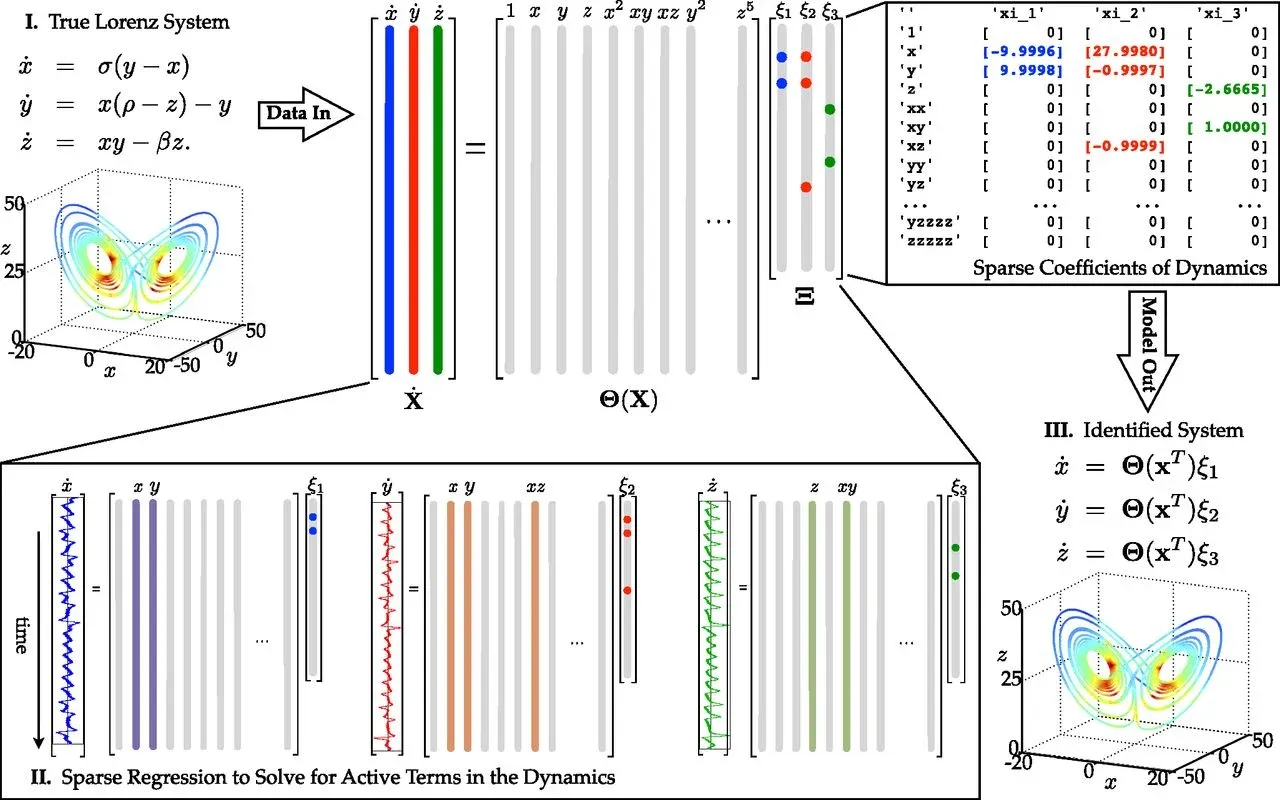
How AI Is Helping Us Understand Complex Systems—Not Just Predict Them

We often think of AI as a tool to predict the future—like guessing the weather, stock prices, or whether someone might get sick. But AI is starting to do something even more powerful: helping us understand the rules behind how complex systems work.

A recent issue of Complexity Thoughts explores this shift, showing how new AI methods are uncovering the hidden patterns behind things like disease spread, traffic flow, brain activity, and more. The goal isn't just to know what will happen—but to figure out why.


From Forecasting to Figuring Things Out

Most AI tools today are built to spot patterns and make forecasts. But these new approaches aim to find the actual equationsthe basic rules that explain how a system behaves over time.

That’s a big leap. It means AI isn’t just guessing anymore—it’s helping build scientific models.

Why Simpler Models Are Better

Many of these studies use a method called sparse modeling. Instead of creating big, complicated equations, these models look for the smallest number of pieces needed to explain what’s going on.

Why? Because most systems—even complex ones—are driven by just a few key factors. If we can find those, we get models that are easier to understand and work with.

This approach is already being used to:

  • Study how fluids flow,
  • Track how diseases spread,
  • Understand patterns in brain signals,
  • And model chaotic systems like weather patterns.


Finding the Right Way to Look at a System

Sometimes, raw data is messy or overwhelming—like thousands of brain signals or climate measurements. Even with powerful tools, it’s hard to see what matters.

One AI method solves this by first learning the best way to describe the system, and then figuring out the rules. It’s like teaching a computer to choose the right map before trying to navigate a city.

A Machine That Thinks Like a Scientist

Another team built what they call a Bayesian machine scientist. Instead of trying one model, it tries out many different ones, tests how well they match the data, and picks the best. It even learns from a large library of past equations, the way a human scientist might rely on years of experience.

When Randomness Is Part of the System

Some systems—like bird flocks or the brain—are naturally unpredictable. They have a lot of randomness built in. Instead of treating that randomness as noise, a new method called a Langevin Graph Network includes it in the model.

This has already led to real discoveries:

  • Showing how birds flock using rules scientists have long suspected.
  • Modeling how harmful brain proteins spread—something important for Alzheimer’s research.

Why This Is a Big Deal

Together, these projects show a big shift in how we use AI:

  • Not just to automate tasks, but to help us discover how the world works.
  • Giving us simple, understandable models we can use to guide action.
  • Making science faster, more open, and easier to explain.

In a world dealing with complex challenges—like climate change, pandemics, and social disruption—this kind of AI could help us not only respond faster, but understand better.

Want to explore more? Check out Complexity Thoughts for links and summaries of these fascinating papers.


Monday, January 20, 2025

Embracing Complexity and Letting Go of Control

Embracing Complexity and Letting Go of Control


Sonja Blignaut, Ben Ramalingam, and Silvio Funtowicz share perspectives that weave together a common theme: the challenge of navigating complexity and the humility needed to do so effectively. Blignaut highlights that “constraints... create order,” suggesting that boundaries aren’t just limitations but tools that make chaos manageable. Ramalingam warns against oversimplification, cautioning us not to break apart a “complex mess” without appreciating how its parts are interconnected. This resonates with Funtowicz’s call to “abandon the idea that you can predict and control,” encouraging us to move away from a rigid, deterministic approach and embrace uncertainty and interdependence.

Together, these insights challenge the impulse to simplify complexity and instead invite us to value the unknown, seeing constraints not as barriers but as guiding frameworks for meaningful engagement.

"Constraints are one of the primary (if not the primary) ways that order is created." 
–Sonja Blignaut, Constraints in Complexity and the BART Framework

"‘Some of the greatest mistakes are made when dealing with a complex mess, by not seeing its dimensions in their entirety, carving off a part, and dealing with this part as if it were a complicated problem, and then solving it as if it were a simple puzzle, all the while ignoring the linkages and connections to other dimensions of the mess.’" 
–Ben Ramalingam, Aid on the Edge of Chaos

"you have to abandon this idea that you can predict and you can control"
Scientific Advice Mechanism, Silvio Funtowicz on Post-Normal Science Advice  


Tuesday, January 07, 2025

7 January 2025

Why is this day important?

Well, of course, that's a stupid question. Every day is important. But how do we turn this day into what it could be? I suppose that’s a silly question too—because, in a way, the day will simply be what it is. The idea of elevating a day to some higher purpose feels like both a privilege and a distinctly human conceit.

So, with all that navel-gazing out of the way, what do I want to do with this day?

One thing I’d like to do is go for a walk. A good, solid mile-and-a-half to two-mile walk where I can immerse myself in the environment—but also step back from it by listening to a book I’m enjoying right now. I’d go for a run instead, but it’s icy and slick, so walking seems like the better choice.

Speaking of the book, it’s The Fool’s Progress by Edward Abbey. I hadn’t realized it was essentially an autobiography—or at least a semi-autobiographical work. I’m sure parts of it are embellished (maybe), but maybe not. I’m about 60% through, and I already want to start it over, knowing now how closely it maps to Abbey’s life. There are some wonderful lines in it. One of my favorites so far is a quote from the protagonist’s father, who’s an anarchist and atheist. He says, “God is just a noise people make when they get tired of thinking.”

If you could turn each day into a project, what would it look like?

I recently came across an outline for project organization and thought it could also work to structure a day. The very first question in the outline is, “Why is this project [day] important?” Below is my answer, but as I thought about it, the next question emerged: What does success look like?

At its most basic level, success is simply to live another day. Some might call that view nihilistic—or something similar—but I see it differently. The act of being and realizing that you are is an incredible thing. To embrace that is, I think, an awesome day.

Some might say that’s too small a goal. But I’d argue that those people aren’t fully appreciating how amazing each day already is. Rather, they may be running from fears by covering their being, and thoughts, with busywork. 

Structure

Next, one of my goals for the day became clear: maintaining structure—or perhaps even improving it. But as I thought about structure, I started to look at it more critically.

Humans love structure. It gives us frameworks to make sense of the world. Even in chaotic environments, structure can emerge. While pure chaos is, by definition, structureless, complex environments often give rise to emergent structures. And it’s in those emergent structures where innovation and creativity thrive. That’s where new ideas and ways of thinking are born.

Highly structured, linear environments—those with predictable patterns—give us things like process flows, rote memorization, and repeated actions. This isn’t necessarily a bad thing, even though the way I’ve framed it here might suggest otherwise. In many situations, structure and predictability are crucial. For instance, consider an engineer designing a bridge or a surgeon planning an operation. Without some level of linear structure, their work would lack the precision and reliability needed for success.

Still, even in fields like medicine, there’s an emergent quality that can’t be ignored. Humans differ enough from one another—both socially and physically—that medicine often requires thinking beyond simple linear approaches. It’s this emergent aspect of care that, in my opinion, we don’t always account for well enough.

And yet, here I am still stuck on the first part of my project outline: Purpose and Outcome for the Day. I haven’t even gotten to the next steps: actions, supporting materials, visioning, context, or how I plan to review the day once it’s complete. But, like any project, I think purpose and outcome are where we should spend most of our time. Purpose and outcome provide the vision that fuels the energy for the work.

OK, I’m yattering now.

Let’s shift gears—here’s a photo and some quotes to ponder.

The Potomac River at the C&O Canal's Widewater


First, my little ramble above reminded me of this quote:
“Don’t just do something, sit there.”

And this one:
“The time is very urgent—we must slow down.”
—Bayo Akomolafe, The Times Are Urgent: Let’s Slow Down

Other Quotes

These quotes, that I chose from my daily Readwise feed, speak to the need to embrace (to surf) the dynamic nature of emotions as they arise and to trust in them. They remind me that simple frameworks for understanding the world often fall short, and as the world evolves, we must adapt to its behavior rather than forcing it into convenient, rigid structures. Maintaining this "surfer" mindset requires exploration and a willingness to accept what one sees—approaching the world with the curiosity of a scientist or a detective in a mystery novel.

“Emotional stoicism and self-control are rewarded, and displays of emotion are punished. Vulnerability is now weakness. Anger becomes an acceptable substitute for fear, which is forbidden.”
—Brené Brown, Rising Strong

“The belief that economic reform would force political liberalization in China has been thoroughly discredited. The fundamental conflict—that Western democracies are threatened by authoritarian regimes—has become obvious to our allies and to responsible foreign policy voices in both parties.”
The Washington Post (Opinion)

Finally, this one from Chip and Dan Heath’s Made to Stick:
“Cialdini believes that a major benefit of teaching using mysteries is that the process of resolving mysteries is remarkably similar to the process of science. By using mysteries, teachers don’t just heighten students’ interest in the day’s material; they train them to think like scientists.”

Saturday, December 21, 2024

Dancing with Systems: Navigating Complexity for Transformative Change

These systems quotes collectively emphasize the importance of understanding systemic behavior (e.g., delays, nested dynamics, resistance), embracing ambiguity, and fostering iterative learning. They advocate for a perspective that balances analysis with action, recognizing that transformative change requires navigating complexity with vision, adaptability, and respect for the interconnected nature of systems

Photo by Alina Grubnyak 

Systems Quotes

"Delays are pervasive in systems, and they are strong determinants of behavior. Changing the length of a delay may (or may not, depending on the type of delay and the relative lengths of other delays) make a large change in the behavior of a system."
–Donella H. Meadows, Thinking in Systems

"Such challenges are often inhibited by individual and organizational ‘defensive routines’, firmly entrenched in minds, setting cognitive and social limits on learning."
–Ben Ramalingam, Aid on the Edge of Chaos

"Defensive routines" is an important concept when it comes to understanding how learning can be inhibited, both individually and organizationally. These routines, as Ben Ramalingam describes in Aid on the Edge of Chaos, are deeply ingrained patterns of thinking and behavior that create cognitive and social barriers to learning.

This idea also reminds me of something I recently came across about organizations exhibiting an "immune response" to resist change efforts. It seems closely related, as both highlight the instinctive resistance to disruption or transformation within systems.

"to date there is a lack of studies that bridge the divide between small case-based interventions and global systems at broader scales, and the complex interactions across scales and processes. This paper works with a leverage points framework to consider systems transformation. It focuses on four individual sustainability interventions in the textile sector and explores how they are embedded within a complex set of nested systems, and how these connected systems shape the transformative potential of the interventions."
–link.springer.com, Processes of Sustainability Transformation Across Systems Scales: Leveraging Systemic Change in the Textile Sector - Sustainability Science

"Understanding processes of systems change therefore requires us to ‘dance with systems’ (Meadows 2001), meaning to learn from and engage with systems through dynamic, rather than static, perspectives, with passion and vision, to understand their functions or purposes and connections, and see how our values and the system properties may interact (Meadows 2011; Constable et al. 2019)."
–link.springer.com, Processes of Sustainability Transformation Across Systems Scales: Leveraging Systemic Change in the Textile Sector - Sustainability Science

Monday, December 16, 2024

The Landscape Approach to Global Health

The relationship between personal health, community health, and landscape health can be understood as an interconnected system, where each component influences and is influenced by the others. From a climate perspective, this connection is especially significant, as environmental changes—such as shifts in temperature, precipitation patterns, or biodiversity—create cascading effects that impact health at multiple levels.

For example, changes in the landscape, such as deforestation or urbanization, can directly degrade air and water quality, leading to increased respiratory illnesses, waterborne diseases, and heat-related conditions. Conversely, the resilience of the landscape—its ability to sustain diverse ecosystems and provide critical services—helps buffer communities from health risks associated with climate extremes, such as floods, droughts, and heatwaves.

Examining these linkages through a climate lens opens the door to innovative approaches to health and environmental stewardship. For instance, restorative practices like reforestation, wetland conservation, and regenerative agriculture offer co-benefits for both the environment and communities. These practices can improve food security, reduce exposure to pollutants, and enhance mental health by providing greater access to green spaces.

The concept of biophilia—our innate connection to nature—further highlights the importance of healthy landscapes. Biodiverse and aesthetically rich environments have been shown to reduce stress, enhance cognitive function, and foster social cohesion. This reinforces the mental and emotional benefits of living in harmony with nature.

Additionally, climate change alters disease dynamics, creating new challenges for public health. For example, shifting ecosystems may provide habitats for disease vectors like mosquitoes, enabling the spread of illnesses such as malaria or dengue fever to regions previously unaffected. This demonstrates the need to integrate climate resilience into public health strategies to mitigate such risks.

Ultimately, the interplay between personal, community, and landscape health forms a dynamic and complex system. Adopting a holistic, climate-informed approach allows us to address the interdependencies between environmental health and human well-being. By doing so, we can create solutions that are more sustainable, equitable, and impactful across scales.

Article

Health and landscape approaches: A comparative review of integrated approaches to health and landscape management

This article explores the relationship between health and the landscape approach, a form of systems thinking. It focuses on three distinct applications of the systems approach, each grounded in unique ontological foundations.

Link to article

Description:

Landscape approaches focus on managing specific areas by bringing together ideas from different fields to create sustainable solutions. The COVID-19 pandemic has had a major impact on how people live, move, and interact with the environment, highlighting the need for health approaches that connect humans and nature. This has led to an increased focus on integrated health approaches in policy discussions.

Approaches like One Health, Ecohealth, and Planetary Health are all types of landscape approaches because they address the connections between health, the environment, and society. This study reviews these health-oriented approaches to understand their shared ideas and unique differences. It looks at their history, how they’ve developed, and their approaches to solving health and environmental challenges.

The study finds that all these approaches share key features, such as systems thinking, working across disciplines, and promoting collaboration across different fields. However, they differ in the specific problems they address, the areas they focus on, and the ontological roots (the underlying mindset) guiding their research. By examining these approaches together, the study suggests ways to strengthen landscape approaches by using health-focused methods to better understand the connections between health and landscapes.

Sunday, December 15, 2024

Quotes for December 15

 Hi everyone, here are the quotes from my readwise stream this morning. Happy Sunday!

People often complain about the present times, but human life has never been better than it is now.


As Yuval Noah Harari states in Homo Deus:
"For the first time in history, more people die today from eating too much than from eating too little; more people die from old age than from infectious diseases; and more people commit suicide than are killed by soldiers, terrorists, and criminals combined."

Despite this progress, social divisions persist. These divisions often rely on "othering" narratives to uphold power structures within their domains—a phenomenon that could be described as "ontological blinkardness." Our institutional silos, our tendency to "other," and our self-centered thinking prevent us from making further progress.

Jim Sidanius and Felicia Pratto highlight this in Social Dominance:

"The split earlier in this century between sociology and social psychology contributed to these divisions and continues to hinder a more comprehensive and rich understanding of the problems of racism, sexism, classism, and general group oppression."

But perhaps, the issue isn’t just out there—maybe it’s me.

Anthony De Mello and J. Francis Stroud, in Awareness, suggest:

"We see people and things not as they are, but as we are. That is why when two people look at something or someone, you get two different reactions. We see things and people not as they are, but as we are."

On growing up, Lulu Miller offers a profound insight in Why Fish Don’t Exist:

"‘Growing up,’ she told me, ‘is learning to stop believing people’s words about you.’"

And maybe, it’s also about letting go. As Silvio Funtowicz said in a discussion on post-normal science advice:

"You have to abandon this idea that you can predict and you can control."


But wait, there's more

Breaking Ontological Silos Through the Zettelkasten Approach

Sönke Ahrens, in How to Take Smart Notes, describes how the Zettelkasten method disrupts traditional, siloed ways of thinking:

"That the slip-box is not sorted by topics is the precondition for actively building connections between notes. Connections can be made between heterogeneous notes – as long as the connection makes sense. This is the best antidote to the impeding way most information is given to us in our learning institutions. Most often, it comes in modular form, sorted by topic, separated by disciplines and generally isolated from other information. The slip-box is forcing us to do the exact opposite: To elaborate, to understand, to connect and therefore to learn seriously."

By avoiding rigid categorization, the Zettelkasten approach encourages a deeper understanding through the creation of meaningful connections, breaking down institutional silos that often isolate knowledge into disconnected disciplines.


Understanding the Difference Between Chaotic and Complex Systems

Per Bak, in How Nature Works, explains the key difference between chaotic and complex systems:

"Chaotic systems have no memory of the past and cannot evolve."

This distinction helps clarify why chaotic systems remain unpredictable and stagnant, while complex systems—like human societies—retain memory and adapt over time.


The Complexity of Humans and the World

The world is undeniably complex, as are humans. Yet, as Ben Ramalingam points out in Aid on the Edge of Chaos, we often try to impose simple solutions on deeply complex problems:

"Aid tends to try and solve simple problems through narrow, prescribed interventions."

This highlights a critical flaw in many systems of aid and intervention: they fail to account for the intricate, interconnected nature of the challenges they aim to address. 

Wednesday, December 11, 2024

Good Morning, December 11

Where I am right now, it’s raining. Despite the weather, I still plan to head out for my run.

Today, I want to share two quotes that resonated with me from my Readwise feed. They touch on themes of kindness and complexity, offering thought-provoking insights into how we interact with ourselves, others, and the world around us.


1. On Kindness (Pema Chödrön, Start Where You Are)

The first quote is by Pema Chödrön and speaks to the power of kindness, particularly the importance of being kind to ourselves. It highlights how our self-treatment radiates outward, influencing our relationships with others. This idea is simple yet profound:

"By being kind to ourselves, we become kind to others. By being kind to others – if it’s done properly, with proper understanding – we benefit as well. So the first point is that we are completely interrelated. What you do to others, you do to yourself. What you do to yourself, you do to others."

This interconnectedness is a reminder that the way we treat ourselves sets the tone for how we engage with the world.

2. On Complexity and Catastrophic Shifts (Per Bak, How Nature Works)

The second quote comes from Per Bak's exploration of complexity in How Nature Works. It delves into the behavior of complex systems and the sudden, dramatic changes—what we often call catastrophes—that can occur within them.

Bak explains that much of the world operates as interconnected systems where small, incremental pressures can lead to stability over time. However, those same pressures, when combined or slightly altered, can suddenly push a system into a completely different state. This is what he describes as a "catastrophic shift."

Here’s the quote:

"If this picture is correct for the real world, then we must accept instability and catastrophes as inevitable in biology, history, and economics. Because the outcome is contingent upon specific minor events in the past, we must also abandon any idea of detailed long-term determinism or predictability. In economics, the best we can do, from a selfish point of view, is to shift disasters to our neighbors."

While the term “catastrophe” often implies disaster, in systems science, it simply refers to rapid, large-scale transformations. These shifts, sometimes called tipping points, can be either beneficial or detrimental. Positive transformations are often celebrated, while negative ones are viewed as crises.

This quote serves as a reminder of the unpredictable nature of complex systems and the importance of resilience and adaptability in navigating them.

Friday, December 06, 2024

Quotes for December 6

Good morning, everyone - or good "time of day" to you since I have no idea what time of day it is for you. 

Later this morning I plan to go for a run - but until that time I will post a quote here for you. (Not a very interesting story, I know; too short, and the plot is, well, pointless)

These are quotes on my Readwise feed that resonated with me this morning.

Today's Quotes


"Remarkably unchanged, mycelium has persisted for more than half of the four billion years of life’s history, through countless cataclysms and catastrophic global transformations."
–Merlin Sheldrake, Entangled Life

"Because of the complex interdependencies, efforts to solve one aspect of a problem may reveal or create other problems."
–Sustainable Communities, Ecosystem Services and Human Well‐being

"In Frederick Douglass’ 1869 speech “The Composite Nation,” he defends Chinese immigrants and says that he believes we're going to become a multiracial, multiethnic democracy one day. For a former slave to be saying that is what makes America unique, and is equally part of America's story."
–Anand Giridharadas, Ro Khanna Wants Progressives to Embrace Patriotism, Aspiration, and Experimentation

HBR's Management Tip of the Day

And while I am here I will add a bonus from Harvard Business Review, their Tip of the Day.

Today’s Tip


Use Notes to Calm Your Public-Speaking Nerves

Speaking on a stage can feel daunting—the elevated platform, unfamiliar setting, and all eyes on you can make your mind go blank. If you’re a nervous public speaker, don’t overlook the power of good notes. They can make a big difference in your delivery, especially if it’s your first time on a stage. 

Before you start your presentation, set your notes on a lectern or a small table on the stage. If your mind goes blank or you lose your place, start walking toward your notes as you’re speaking. This purposeful movement looks natural and ensures you’re in position to glance down and find your place without disrupting your flow.

Having a water bottle on stage is also useful. When stuck, take a sip while nodding thoughtfully, glance at your notes, and then continue. This brief pause feels natural and helps you reset without drawing attention to your lapse. If you find yourself stuck and unable to look down at your notes, acknowledge the pause with humble humor. Try saying something like, “I had the most brilliant point, and it just escaped me!” Or you can pause for questions: “Let me stop here and see what questions you have, then I’ll summarize what we’ve covered so far.” Confidence and authenticity will keep your audience engaged.

This tip is adapted from “Nervous About Public Speaking? Here’s How to Use Notes Like a Pro.” by Allison Shapira.

Wednesday, December 04, 2024

Quotes for Wednesday, December 4th – December the 4th be with you.

Good happy December 4. Everyone, Wednesday, midweek, all these awesome aspects about the day. It's a short week for me. I'll be out of the office Thursday and Friday. So, really, today is my Friday.

Unlike yesterday, today, there were a lot of great quotes in my feed and I share a subset that resonated for me.

Quotes


"What work means to people often has less to do with what tasks they are actually performing than with how they relate to and compare themselves to other people."
– Keith Payne, The Broken Ladder

"Somehow we've entered a world in which we obsess over structural reforms and standardized tests, but skirt around the moral and psychological traits that are at the heart of actual success."
– sfgate.com, Self-Control Is the Key to Success (I know, an odd source, but that is what my app (readwise) captured. If interested, search the title.

"The key to sustainability lies in enhancing the resilience of social-ecological systems, not in optimizing isolated components of the system."
– Brian Walker PhD, Resilience Thinking

"When it comes to the long run, researchers struggle to find any measurable connection between our intentions and our actual behaviour"
– Sönke Ahrens, How to Take Smart Notes

"It was a brilliant idea: You have no responsibility to live up to what other people think you ought to accomplish. I have no responsibility to be like they expect me to be. It’s their mistake, not my failing."
– Richard P. Feynman, Ralph Leighton, Edward Hutchings, and Albert R. Hibbs, "Surely You're Joking, Mr. Feynman!" (The cite is almost as long as the quote!)

"This book will show that while economic institutions are critical for determining whether a country is poor or prosperous, it is politics and political institutions that determine what economic institutions a country has."
– Daron Acemoglu, James Robinson, Why Nations Fail